Introduction: Don’t Let a “Hague Apostille” Block Your Child’s Further Study, Employment, or Household Registration
“Teacher, my child has received their foreign diploma, but the school says we still need to get a Hague Apostille. What exactly is that?”
“We used to hear that we had to go through consular legalization, but now we are told that is no longer needed. Which one is correct?”
After years of working in post-study-abroad services, I receive a large number of similar questions almost every graduation season. When international students and parents prepare documents for returning to China, they are most easily confused by “Hague Apostille specifics”: which documents need to be processed, where to go, whether to notarize first or apostille first, what to do if documents need to be reissued, and whether different diploma formats will affect the certification.
In fact, the Hague Apostille is not as complicated as it seems. After the Convention Abolishing the Requirement of Legalisation for Foreign Public Documents officially took effect in China on November 7, 2023, the circulation of public documents between China and contracting states has been greatly simplified. Many procedures that previously required “Ministry of Foreign Affairs authentication + embassy/consulate legalization” now only require a single Hague Apostille.
In this article, I will break down the Hague Apostille specifics into practical, actionable steps to help you avoid common mistakes. Whether you are preparing to study abroad, about to return after graduation, or a parent helping your child prepare documents, this can serve as a useful checklist.
1. What Are the Hague Apostille Specifics? How Is It Different from Consular Legalization?
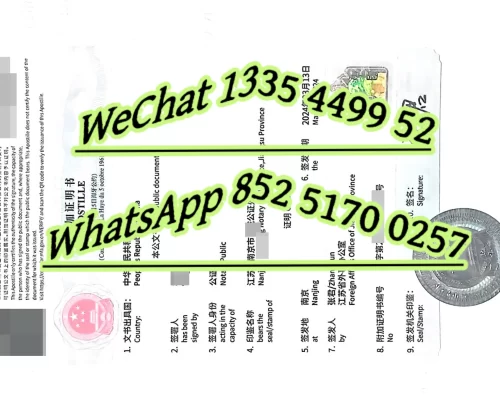
Hague Apostille, also known as an Apostille, is an additional certificate issued under the Convention Abolishing the Requirement of Legalisation for Foreign Public Documents. Its main purpose is to certify that the signature, seal, or stamp on a public document is authentic, so that the document can be used directly in other contracting states.
Under the Apostille Convention framework, an Apostille is not a recognition of academic qualifications, and it does not evaluate the content of the document. It only solves one question: Was this document truly issued by the stated institution?
For international students and parents, Hague Apostille specifics usually include the following:
-
Academic documents: diploma, degree certificate, transcript, certificate of enrollment, proof of education;
-
Identity documents: birth certificate notarization, kinship notarization, marriage certificate notarization;
-
Legal documents: notarized criminal record check, power of attorney, declaration;
-
Other public documents: school admission letters, employment certificates, medical examination reports, etc.
The biggest difference between a Hague Apostille and consular legalization lies in the number of procedural layers:
-
Consular legalization usually requires “notarization/issuing institution authentication → Ministry of Foreign Affairs authentication → embassy/consulate legalization in the destination country,” which involves multiple steps and a long processing time;
-
Hague Apostille only requires “notarization/issuing institution → competent authority issues an Apostille certificate,” which is completed in one step and is valid between contracting states.
However, it is important to note that a Hague Apostille is only valid between contracting states to the Apostille Convention. If the destination country is not a contracting state, traditional consular legalization is still required. This is a point many parents easily overlook, so it is recommended to confirm whether the destination country is on the list of contracting states before applying.
2. Why Must International Students and Parents Understand the Hague Apostille in Advance? 3 Practical Reasons
Many families only realize the importance of the Hague Apostille at the last minute. As a result, they either pay more for expedited service or delay their return for household registration, employment, or further study. Understanding it in advance has at least three practical benefits:Graduation certificate, diploma, transcript, educational background, academic certification, production and purchase
1. It Directly Affects Overseas Diploma Verification and Employment Review
After returning to China, if international students want to work in state-owned enterprises, public institutions, or civil service positions, or if they want to enjoy the benefits of the overseas returnee household registration policy, they usually need to submit authenticated academic documents. The Hague Apostille is often a required prerequisite. Without it, subsequent verification by China’s CSCSE and personnel review may be blocked.
2. Reissuance Is Far More Troublesome Than First-Time Processing
If a diploma, transcript, or other document is lost and needs to be reissued, it often requires contacting the overseas school again, and the timeline is unpredictable. Front-line study-abroad service advisors recommend scanning and backing up all documents immediately after receiving the diploma, and confirming whether a Hague Apostille is needed. Do not wait until just before the deadline to start.
3. Avoid Being Misled by Old Procedures and Spending Unnecessary Money
A common misconception is that all cross-border documents still require consular legalization. In fact, China has now applied the Apostille Convention, and between China and contracting states, embassy/consulate legalization is no longer required. If you still follow the old procedures, you may not only make unnecessary trips but also pay extra intermediary fees.
3. The 5 Key Steps for International Students to Obtain a Hague Apostille (Taking a Foreign Diploma/Transcript for Use in China as an Example)
This section is the “how to do it” part that many parents care about most. Below, I have broken the process into five key steps. I recommend saving this as a reference.
Step 1: Confirm Whether the Country That Issued the Document Is a Contracting State to the Apostille Convention
The premise of a Hague Apostille is that both the country that issued the document and the destination country are contracting states. China officially applied the Convention on November 7, 2023. If your child studied in a common destination such as the United Kingdom, the United States, Australia, Canada, Japan, South Korea, or Singapore, these are usually on the list of contracting states. However, it is still recommended to check the latest list of contracting states on the official website of the Chinese Ministry of Foreign Affairs or China Consular Affairs before applying.Graduation certificate, diploma, transcript, educational background, academic certification, production and purchase
Step 2: Prepare the Original Document or a Notarized Copy
For foreign diplomas, degree certificates, and transcripts, you generally need to provide:
-
The official original document issued by the school;
-
Or a copy verified by the school or a notary institution;
-
Some countries also require a certified translation.
Note: Different countries have different requirements for “original,” “copy,” and “translation.” For example, some countries allow electronic transcripts issued by the school to be processed directly, while others require paper originals.
Step 3: Identify the Competent Authority in the Country That Issued the Document
A Hague Apostille is not obtained in the destination country; it is obtained in the country that issued the document. Each country has designated competent authorities, for example:
-
United States: the Secretary of State’s office in each state;
-
United Kingdom: the Foreign, Commonwealth & Development Office;
-
Australia: the Department of Foreign Affairs and Trade or local notary institutions;
-
China: the Ministry of Foreign Affairs and local Foreign Affairs Offices.
It is recommended to search for “Apostille authority + country name” on the official government website of the issuing country to avoid fake intermediary websites.
Step 4: Submit the Application and Wait for the Apostille Certificate to Be Issued
Common application methods include:
-
Online application;
-
In-person submission;
-
Submission by mail.
After submission, the competent authority will attach a standardized Apostille certificate to the document. According to the Convention, an Apostille certificate generally includes fixed items such as the issuing country, signatory information, seal information, and date of issuance. The format is standardized, but the language may vary depending on the country.
Step 5: Verify the Information and Keep the Document Safe
After receiving the Apostille certificate, be sure to check:
-
Whether the name spelling is consistent with the passport;
-
Whether the school name and major name are consistent with the diploma;
-
Whether the issuing institution name and seal are clear;
-
Whether the Apostille certificate number and date are complete.
If any errors are found, contact the issuing authority immediately for correction. It is recommended to scan and archive a color copy and keep the original in a fixed document folder.
4. How to Apply for a Hague Apostille for Chinese Documents Going Abroad? A Staged Checklist
If your child is preparing to study abroad and needs to bring Chinese documents such as birth certificate notarization, notarized criminal record check, diploma, or transcript to another country, the process is slightly different. For Chinese documents, the Hague Apostille generally follows the order of “notarize first, then apostille.”
Stage 1: Prepare Basic Materials
-
Applicant’s ID card and household registration booklet;
-
Original documents that need to be processed, such as diploma or birth certificate;
-
Some notarization items also require photos or proof of relationship.
Stage 2: Notarize at a Notary Office
Chinese documents cannot directly receive a Hague Apostille. They usually need to be notarized by a notary office first. For example:
-
Birth certificate notarization;
-
Notarized criminal record check;
-
Academic qualification notarization;
-
Transcript notarization.
The core of this stage is: the notarial certificate must be authentic, standardized, and consistent with the original content.
Stage 3: Submit to the Foreign Affairs Office for Hague Apostille
After obtaining the notarial certificate, submit it to the Ministry of Foreign Affairs or an authorized local Foreign Affairs Office for the Hague Apostille. Some regions support one-stop service through the notary office, so you can ask directly when handling the notarization.
It should be noted that different local Foreign Affairs Offices may have different requirements for materials, so it is recommended to call in advance to confirm and avoid unnecessary trips.
5. Reissuance Requirements and Diploma Formats: Common Questions Explained
During my work, two types of questions are especially common: one is “What should I do if the document is lost?” and the other is “Will different diploma formats cause problems?”
How to Reissue a Lost Diploma or Transcript?
-
If the original diploma is lost, first contact the overseas school to apply for a replacement or an official graduation certificate;
-
The reissued document also needs to be processed through the Hague Apostille according to the original procedure;
-
If the Apostille certificate itself is lost, contact the original issuing authority to apply for a replacement or reissuance. Specific policies vary by country.
Will the Diploma Format Affect the Hague Apostille?
No. Diploma formats from foreign universities vary greatly. Some look like award certificates, some look like standard certificates, and some are even issued only in electronic form. The Hague Apostille focuses on the authenticity of the issuing institution and signature, not the appearance or format of the diploma. Therefore, regardless of whether your child studied business, engineering, computer science, art and design, or any other specialized major, the certification process depends mainly on the type of document and the issuing country, not on the major itself.
However, note the following: if the diploma was not issued directly by the official school but by a third-party institution, or if the document has been altered or contains inconsistent information, the certifying authority may refuse to process it. Never use forged or altered documents, as this may leave a negative record.
6. 5 Common Misconceptions and Avoidance Tips
-
Treating a Hague Apostille as the same as China’s CSCSE overseas diploma verification
A Hague Apostille verifies the authenticity of the document; the CSCSE verification confirms the legality and correspondence of overseas academic qualifications for use in China. They are handled by different institutions, serve different purposes, and cannot replace each other. -
Assuming every country can process a Hague Apostille
A Hague Apostille is only valid between contracting states. If the destination country is not a contracting state, traditional consular legalization is still required. -
Thinking you must return to China or the study-abroad country to process it in person
Many countries support mail-in applications or authorized agents. Some embassies and consulates also provide relevant guidance. Whether in-person processing is required should be checked with the competent authority in the issuing country. -
Ignoring translation requirements
Some destination countries require an official translation attached to the document. The translation itself may also need to be certified. It is recommended to clarify the requirements of the organization using the document in the destination country in advance. -
Reversing the order of notarization and Hague Apostille
For Chinese documents, the usual order is “notarize first, then apostille.” For foreign documents, it depends on the issuing country’s requirements: some can be apostilled directly, while others require notarization first. Doing it in the wrong order may waste time and money.
FAQ: 3 High-Frequency Questions About Hague Apostille Specifics
Q1: What documents are included in Hague Apostille specifics? Which documents do international students usually need to apostille?
A Hague Apostille applies to public documents such as diplomas, degree certificates, transcripts, birth certificate notarizations, notarized criminal record checks, marriage certificates, and powers of attorney. International students returning to China most often need to apostille diplomas, degree certificates, and transcripts. Those planning to study abroad often need birth certificate notarization and notarized criminal record checks.
Q2: What is the difference between a Hague Apostille and China’s CSCSE overseas diploma verification?
A Hague Apostille certifies that the signature and seal on a document are authentic, allowing the document to be used between contracting states. The CSCSE verification confirms the legality and correspondence of overseas academic qualifications for use in China, such as for academic recognition, household registration, and employment. They are handled by different bodies and cannot replace each other.
Q3: How long does a Hague Apostille take? Is expedited service reliable?
Processing time varies by country and institution, typically ranging from a few working days to several weeks. Some institutions offer expedited service, but be sure to apply through official channels and avoid unverified intermediaries. It is recommended to allow sufficient time in advance and not wait until the last minute.
Final Words: Sorting Out the Process Is More Useful Than Worrying
At its core, a Hague Apostille is a “document trust procedure.” For international students and parents, the most important thing is not to memorize every country-specific detail, but to understand the underlying logic: first confirm whether the country is a contracting state, then identify the issuing country and competent authority, and finally follow the path of “original document—notarization/verification—apostille.”
If you are preparing study-abroad or return-to-China documents, I recommend saving this article and checking it step by step before processing. You are also welcome to leave a comment with your destination country or specific document type, and I will try to provide some directional advice based on my experience. If you have encountered pitfalls, please share your experience as well to help more families avoid unnecessary detours.
Call to Action: If you would like a “Hague Apostille Processing Checklist” or a “Study Abroad Return Document Self-Check Form,” reply “checklist” in the comments, and I will prepare a simplified version for your reference. You can also share this article with parent groups that may need it, so more people are not misled by outdated procedures.