
Body Text
When you type “What are the advantages of UK universities?” into a search engine, I can perfectly imagine the balancing act going on in your mind. On one side, you hear online chatter dismissing UK master’s degrees as “watered down”; on the other, your family is weighing the serious investment of hundreds of thousands in your education. You are probably wondering: Is a UK degree still competitive after Brexit? Can you really learn something substantial in just one year? Can you actually stay and work after graduation? These doubts are all too familiar to me. Over the past decade in education consulting, I have walked alongside thousands of families through this very dilemma, and I’ve seen too many students make life-changing decisions because they clearly understood the true value of a British education.
Today, I don’t want to just throw a bunch of ranking data at you. Instead, I want to sit down with you, as if over a cup of tea, and peel back the layers of what makes UK universities special. Without exaggeration or sugarcoating, let’s talk honestly about what is genuinely good, and how you can leverage these strengths for your own benefit. By the end of this piece, you will not only understand what the advantages of UK universities are, but you will also know how to translate these advantages into a concrete, powerful application strategy based on your own circumstances.
1. What Are the Advantages of UK Universities? Start with These 5 Irreplaceable Core Values
If I had to sum it up in one sentence, the magic of UK higher education lies in helping you achieve an efficient academic and professional leap using more compact time and more concentrated resources. Let’s break this down into five core values that are worth your careful consideration:
-
Compact Degree Length, a Win for Both Time and Money
Undergraduate degrees in England are typically three years, and taught master’s programs take just one year. This is 1-2 years shorter than in most other countries, meaning you can enter the job market and start accumulating experience earlier. It also means significantly lower living costs and accommodation fees. A common misconception is that “shorter time equals less learning equals a less valuable degree.” In reality, the UK curriculum strips out a vast number of general education electives and immerses you deeply in your chosen subject from day one. The course density and the demands for self-directed learning are very high. -
An Incredible Density of Top-Ranked Universities, with Almost No Ceiling on Subject Choice
Within a relatively small landmass, the UK is home to over 15 universities consistently ranked in the QS World Top 100. Whatever your intellectual passion—classical literature, artificial intelligence, fashion management, sports science, renewable energy—you can almost certainly find a globally top-tier program. This high concentration of quality educational resources gives you an extraordinarily rich set of options without ever having to leave the country. -
The Reintroduction of the Graduate Route Visa, Opening a Wider Career Launchpad
This is one of the biggest pieces of good news in recent years. Bachelor’s and Master’s graduates can now apply for a 2-year post-study work visa, and PhD graduates get 3 years. Crucially, this visa does not require employer sponsorship. You can use those two years to work, intern, attend interviews, or start a business. It provides a precious “buffer zone” and “testing ground,” allowing you to truly convert your academic qualifications into international work experience. -
A Meticulous Student Support System That Cares About More Than Just Your Grades
UK universities commonly have international student advisors, academic skills centers, multilingual counselling services, and extensive orientation programs. According to surveys by the UK’s Higher Education Policy Institute, international student satisfaction with welfare support has remained consistently high. This means that when you face culture shock, academic pressure, or career confusion, you are not alone. -
A Multicultural Environment, a Natural Training Ground for a Global Mindset
As a gateway between Europe and the world, UK campuses are filled with students from every corner of the globe. You will hear perspectives from different continents in your class discussions and collaborate with peers of different nationalities on group projects. This daily, lived experience of cross-cultural collaboration is itself a core soft skill for the future workplace.
2. Short Length, High Value? Unpacking the Academic Advantages and Unique Majors
Many parents’ deepest worry is whether a “one-year master’s degree is watered down.” I want to dismantle this question by looking at the underlying logic.
Why is it short? Because it is focused.
UK undergraduate programs don’t require years of general education courses unrelated to your major; you dive straight into the core of your subject. A master’s degree, though only one year, is typically divided into three semesters. The first two are packed with intensive taught modules and seminars, and the third is dedicated entirely to an independent research dissertation or a major project. One piece of advice from experienced teachers: don’t simply equate “class hours” in the UK with those in other systems. UK universities place a huge emphasis on self-directed learning. Professors will give you long reading lists, and you’re expected to digest the material before class, with contact hours used primarily for deepening discussion and resolving questions. The independent research skills and critical thinking developed under this model are qualities highly valued by employers everywhere.
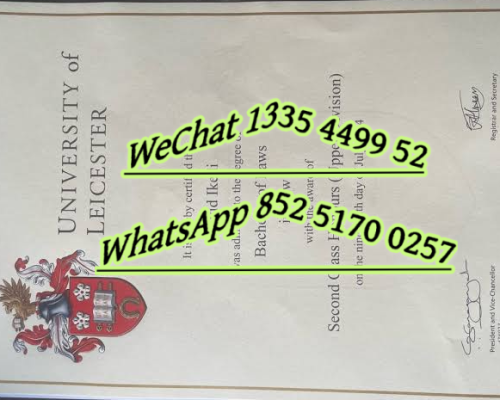
莱斯特大学毕业证-Diploma from the University of Leicester
Examples of Distinctive Majors: It’s Not Just Business and Finance
When people think of UK study, they often first think of finance and business. These are certainly strong, but the advantages run much deeper. Some programs are global benchmarks in their fields, and knowing about them can open up new ways of thinking:
-
Sports Science and Management: Loughborough University’s sports-related subjects have been ranked first in the world for years, backed by top-tier facilities, deep partnerships with elite sports organizations, and rigorous research.
-
Art and Design: The University of the Arts London (UAL), including Central Saint Martins and the London College of Fashion, is an incubator for the global creative industries. Its industry connections and network are unmatched.
-
Translation and Interpreting: The interpreting programs at the University of Bath, University of Leeds, and Newcastle University are key talent pipelines for the UN and EU institutions, renowned for practical training and industry standards.
-
Actuarial Science and Risk Management: City, University of London’s Bayes Business School (formerly Cass), located on the doorstep of the City of London, offers one of the world’s most respected programs in actuarial science.
-
Environmental and Marine Science: The National Oceanography Centre at the University of Southampton, and the University of East Anglia’s authoritative position in climate change research, offer world-class scientific platforms.
These “hidden champion” programs often shine far brighter in their specific industries than their overall university ranking would suggest. This is exactly the kind of deep dive information we need to uncover during the selection process.

萨塞克斯大学毕业证-Diploma from the University of Sussex
3. Beyond the Diploma: What “Hidden Perks” Can You Take Away from a UK University?
A huge part of the value of studying abroad comes from beyond the classroom. These perks, offered by UK universities, can qualitatively change the return on your investment.
-
NHS Healthcare: After paying the Immigration Health Surcharge, international students can access the UK’s National Health Service. This means that visits to the doctor, emergency treatment, and basic care won’t typically incur massive additional fees. This is a very real form of peace of mind.
-
Abundant Scholarship Resources: The UK government and universities offer numerous scholarships for international students, such as the Chevening Scholarships, the GREAT Scholarships, and many university-specific awards. Some are automatically granted with an offer, others require a separate application. A little research could significantly ease your financial burden.
-
Powerful Careers Services: From CV polishing and mock interviews to industry networking evenings and large-scale career fairs, your university’s careers centre is there for you from day one. Some universities even offer continued career support for 2-3 years after graduation. My frontline experience reminds me that many students only think about the careers centre when graduation is looming, but you should really start leveraging these resources the moment you enrol.
-
The Alumni Network: This is an invisible, global web of connections. In the UK, alumni culture is very strong. A single coffee chat with an alumnus could bring you a valuable internal job referral.

4. How to Turn “UK University Advantages” into Your Application Advantage: Key Steps and Practical Tips
Now that you see the benefits, you might feel excited, but the crucial next step is making these advantages work for you. This is the process of moving from “what” to “how.”
Step 1: Redefine Your University Selection Criteria
Don’t just look at overall rankings. First, ask yourself: do I want to leverage the short UK degree length to enter the workforce quickly, or do I want to focus deeply on research in a quiet, secluded university town? If your goal is the former, universities with close industry ties and frequent recruitment events, like Warwick or Manchester, will suit you better. If it’s the latter, a collegiate and academically pure environment like Durham or St Andrews might give you more peace of mind. Put your personal study-abroad goal first, and then use the advantages of UK universities to match it.
Step 2: Research the Course Content Deeply, Not Just the Course Title
This is a step 90% of applicants skip. Two programs both called “Marketing” can be worlds apart: one might focus on data analytics and modeling, the other on creativity and consumer psychology. You absolutely must go to the university website, download the program handbook, and read the teaching aims and assessment methods for each module. Imagine yourself in that lecture theatre—would the content genuinely excite you?
Step 3: Prepare for Language Tests with a Clear Logic
UK universities often have high IELTS requirements and pay increasing attention to “sub-scores.” For productive skills like speaking and writing, a highly effective IELTS speaking improvement technique is to practice a three-part structure: “Opinion-Reason-Example.” Pick a topic each day, force yourself to form this logical loop in one minute, then record and review it. This is far more effective than memorizing templates and can fundamentally improve your coherence and expressive confidence.
Step 4: Show Your “Fit” in Your Personal Statement
What admissions tutors most want to see is why you must do this specific course, and what you have done to prepare for it. You can subtly echo the advantages of UK universities in your essay. For example: “I am choosing a one-year Master’s in Finance because I already have a clear career plan and want to enter investment analysis as quickly as possible through a compact, high-efficiency program. Your ICMA Centre’s simulated trading room and close industry links are precisely the platform I need to accelerate my professional growth.” A statement like this is far more powerful than saying “your university is highly ranked and prestigious.”
Important Note: The application policies, institutional recognition lists, and language requirements for UK universities can be updated annually. The advice in this article is based on general patterns. The most authoritative information is always the latest admissions page published on the official website of your target program. Please make sure to verify the details personally.
5. Stories from the Frontline: Two Real Examples of How These Advantages Changed Trajectories
I want to share two real-life stories I’ve witnessed (with details anonymized), which may help you feel more concretely how the advantages of a UK education manifest themselves.
Story 1: Using a One-Year Master’s to Pivot Careers
Student A graduated from a Chinese 211 university with a degree in English and worked for two years before wanting to transition into fashion marketing. She chose UAL’s Master’s in Fashion Marketing. The one-year, high-intensity program didn’t just give her systematic marketing knowledge; more importantly, London’s industry talks, brand collaboration projects, and vast alumni network helped her secure an internship at a British independent designer brand before graduation. On the day of her final project defense, the internship was converted into a full-time job. She said that if she’d been on a two-year program, she might have missed the brand’s expansion phase. The time advantage of the UK system turned into a concrete, real-world career window for her.
Story 2: When a Specialist Program Outshines a Bigger Brand Name
Student B was agonizing between an Education MA at UCL and a Sport Management MSc at Loughborough University. He loved sports, but his family leaned towards UCL’s ranking. After an in-depth comparison, he discovered that Loughborough’s program had the UK’s largest network in the sports industry, with modules containing live projects directly tied to Premier League football clubs. He followed his heart and chose Loughborough. Upon graduation, he landed a job through an on-campus recruitment event directly at a top international sports marketing agency’s London office, now handling partnerships in the Chinese market. His peers are spread throughout major sports brands. This choice allowed him to maximize the “industry dominance” advantage that UK universities offer in their specialist fields.
Frequently Asked Questions (FAQ)
Q1: What are the specific advantages of UK universities compared to those in the US?
A: The most intuitive difference lies in the degree length and total cost. A UK bachelor’s is 3 years and a master’s is 1 year, which is more compact than the US system. This means earlier graduation and lower overall expenditure. Academically, the UK leans more towards specialist depth and independent research, focusing you on your subject from the start, whereas the US emphasizes a liberal arts education and flexibility. Also, the UK has recently adopted a friendlier graduate visa policy, offering a clear pathway to stay and work. Neither is absolutely better; the key is which system suits you best.
Q2: A UK Master’s is only one year. Will it be recognized by the Ministry of Education and employers back home?
A: Please rest assured. As long as the university is on the list of institutions recognized by the Chinese Service Center for Scholarly Exchange, the degrees awarded are officially recognized. Regarding employers, HR professionals in large state-owned enterprises, multinationals, and private companies are now very familiar with the one-year UK master’s model. They place much more weight on the university you attended, the quality of your specialization, and the real abilities you demonstrate in interviews, rather than simply the length of your degree.
Q3: To make the most of the career advantages, when should I start preparing for the job search?
A: The best time is to start thinking about it before you even depart. The moment you land in the UK, you can register with your university’s careers centre and start attending workshops. For one-year master’s students, the recruitment season often kicks off just as you’re starting your first semester. Don’t wait until you’re about to graduate to take action. Use your university’s job-seeking resources and the Graduate Route visa policy fully to turn the possibility of “working in the UK” into a reality.
What are the advantages of UK universities? By this point, you may have grasped that it’s not something that can be measured by a single yardstick. It’s a composite value, an educational package that bundles together academic rigour, time efficiency, career support, and life experience. It’s not the right path for everyone, but for a young person with clear goals, a hunger for rapid growth, and a willingness to proactively embrace challenges, it is an energy-packed springboard of astonishing power.
If you are currently holding your own background and wrestling with how to apply these advantages to your own situation, you’re welcome to leave a comment with your “Undergrad Uni + Major + Intended UK Specialization” , and I’ll help you do a quick directional diagnosis. At the same time, I’ve prepared a 【UK University Core Advantages & Selection Planning Comparison Chart】 , which clearly lays out the strengths of different types of universities, degree length comparisons, and key application timelines. Comment “Comparison Chart” below, and I will send it to you for free. I hope it helps you see your future path a little more clearly.