Introduction
“Are there many universities in Argentina? What’s their standard like? Are there any good ones worth attending?” When I first started speaking with students interested in South America, most asked about Brazil. Those who mentioned Argentina almost always carried a tone of curiosity mixed with hesitation. Everyone knows the country’s football and tango inside out, yet knows almost nothing about its higher education system.
In fact, Argentina has one of the oldest university traditions in Latin America, and its public universities are free and open to everyone — including international students. This is a key piece of information that is easily overlooked but powerful enough to change a study-abroad budget decision. So, how many universities are there in Argentina? Which ones are truly worth investing several years of your life to attend? In this article, I will draw on a decade of observing the Latin American education sector to provide you with clear answers and a practical framework for choosing a school.

How Many Universities Are There in Argentina? Understanding the Overall Landscape
According to official statistics from Argentina’s Ministry of Education, the country has approximately 130 universities, plus over 1,600 non-university higher education institutions (such as teacher training colleges and technical institutes). Our focus is on these 130-plus universities that have full authority to award bachelor’s, master’s, and doctoral degrees. They fall broadly into two major categories:
-
National Universities: Funded by the national government, numbering around 60 and spread across all provinces. Their core defining feature is that they are tuition-free for all students, including international students at both the undergraduate and graduate levels.
-
Private Universities: Numbering close to 70, operated by private or religious entities, and they charge tuition fees. Some are research-oriented institutions striving for academic excellence, while others focus more on professional training and flexible study schedules.
A common misconception is that “free automatically means low quality.” In reality, Argentina’s top universities are precisely several long-established national universities. They ensure quality through rigorous entrance selection and academic attrition rather than by setting high tuition barriers. The consensus among frontline educators is this: the undergraduate education provided by Argentina’s top public universities is among the most solid in Latin America, but the academic pressure should not be underestimated.

Top Recommended Universities in Argentina: Selected by Reputation and Strengths
The following five universities are the ones I believe are most worth recommending, after repeated verification based on academic reputation, program strengths, and genuine feedback from international students. All of them are recognized by the Chinese Service Center for Scholarly Exchange for degree authentication purposes.
1. University of Buenos Aires (UBA) – Latin America’s Academic Lighthouse
-
Why it’s recommended: Argentina’s largest and highest-ranked national comprehensive university, consistently placing first in Argentina in the QS World University Rankings. It has produced multiple Nobel laureates and Argentine presidents.
-
Featured majors: Medicine, Law, Architecture, Social Sciences, Agronomy.
-
Study experience: Undergraduate study begins with the famous “CBC” (Ciclo Básico Común), an intensive foundational common course block that everyone must complete before entering their specific faculty – a highly distinctive academic filtering mechanism. Tuition is completely free, but you need to budget ahead for the living costs in the city of Buenos Aires.
2. National University of Córdoba (UNC) – One of the Oldest Universities in the Americas
-
Why it’s recommended: Founded in 1613, it is Argentina’s oldest university and the second-oldest university in the entire Americas. Its campus is itself part of a UNESCO World Heritage site.
-
Featured majors: Engineering, Chemistry, Astrophysics, Medicine, History.
-
Study experience: Combines classical scholarly heritage with modern scientific output. The city of Córdoba is Argentina’s second-largest, but its cost of living is far lower than the capital, making it a very cost-effective choice. Student activism and cultural life are extraordinarily rich.
3. National University of La Plata (UNLP) – A Stronghold of Research and Museums
-
Why it’s recommended: Renowned for natural sciences, museum studies, and its observatory. The university has an extremely high density of museums and research institutes, ideal for students who want to immerse themselves in a research atmosphere.
-
Featured majors: Natural Sciences, Astronomy, Veterinary Medicine, Fine Arts, Journalism.
-
Study experience: The city is planned and orderly, with a pure academic atmosphere. For international students seeking in-depth research in the natural sciences, the university’s lab resources and its supervisors’ openness are very welcoming.
4. National Technological University (UTN) – The Gold Standard for Engineering and Technology
-
Why it’s recommended: Argentina’s most prestigious specialized engineering and technology university. Its R&D capabilities in areas like aerospace engineering and nuclear engineering are at the forefront in Latin America.
-
Featured majors: Aerospace Engineering, Civil Engineering, Electronic Engineering, Information Technology.
-
Study experience: Academic standards are extremely strict, and the attrition rate is high, but graduates are held in high esteem within Argentina’s and South America’s engineering communities. For students who genuinely love engineering and are willing to undergo high-intensity training, it is an exceptional environment for growth.
5. Austral University – A Small, Elite Private Research University
-
Why it’s recommended: One of Argentina’s highest-ranked private universities, known for its strengths in management, law, and international relations. It has a tightly knit network of alumni in business and government.
-
Featured majors: Business Administration, Law, Political Science, International Relations.
-
Study experience: Charges tuition but offers a wide range of scholarships and English-taught programs. It is ideal for international students with a clear career path who aim to enter the spheres of business and politics in Latin America. Small class sizes and personalized mentorship are its core competitive advantages.
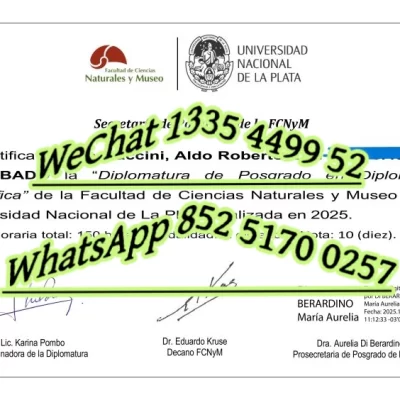
拉普拉塔国立大学文凭-Diploma from the National University of La Plata
Key Points to Know When Applying to Argentine Universities
The application process for Argentine universities is distinct from that of Europe or North America, with each institution exercising a high degree of autonomy. Prepare the following points well in advance:
-
Language is the first hurdle: The vast majority of undergraduate and graduate courses are taught in Spanish. National universities generally do not offer language foundation years. It is recommended to have reached a DELE B2 level or equivalent before applying. Some private universities offer English-taught programs, but daily life still heavily depends on Spanish.
-
Degree recognition and secondary school equivalency: To apply for an undergraduate program, you must have completed high school and process a “secondary school equivalency recognition” required by the Argentine Ministry of Education. This procedure can take a long time, so it is recommended to start at least six months in advance.
-
Admission methods vary by institution: At UBA, undergraduates must first complete the CBC block. Most other national universities, like UNC, have an “introductory orientation course” that must be passed before entering the main program. Private universities mostly use an application review system, which is relatively more flexible for international students.
-
Visa and residency: Once admitted, you apply for a student visa using the documents provided by the university. Be sure to allow at least 2–3 months for visa processing. International students usually enter the country under “temporary residency” status and must remember to renew it on time.
Study Costs and Real-Life Expenses
-
National Universities: Tuition-free, with only small administrative service fees, totaling just a few hundred Chinese yuan per year.
-
Private Universities: Annual tuition ranges roughly between 20,000 and 80,000 Chinese yuan, varying significantly depending on the program and institution.
-
Cost of living: In the capital, Buenos Aires, monthly living expenses are approximately 4,000–6,000 Chinese yuan. In inland cities, you can manage on around 3,000–4,000 yuan per month.
-
Part-time work and internships: A student residency permit generally does not allow formal employment. However, policies are occasionally adjusted in response to economic conditions; you should verify the latest regulations with the immigration office. Internship opportunities are mostly concentrated in the capital and usually require a formal agreement signed between the university and the host organization.
Frequently Asked Questions (FAQ)
Q: Are Argentina’s national universities really completely free? Does this apply to international students too?
Yes. Argentina’s national universities are tuition-free for all enrolled students — regardless of nationality — at both the undergraduate and graduate levels. This is guaranteed by the “free public university” principle enshrined in Argentina’s constitution. However, living expenses and visa-related costs must still be covered by the student.
Q: Are degrees from Argentine universities recognized back in my home country?
As long as the university and program you attend are on the recognized list of your home country’s credential evaluation service, you can successfully obtain your overseas degree authentication after graduation. Argentina’s major national universities and high-quality private institutions are all on the list. It is strongly recommended to make a final confirmation on the official evaluation agency’s website before applying.
Q: If I don’t speak Spanish, can I still apply to an Argentine university?
You can, but the options are very limited. Only a small number of private universities offer a handful of English-taught master’s programs, and undergraduate instruction is almost entirely in Spanish. Even if you are accepted into an English-taught program, daily life and administrative processes still require Spanish, so it is strongly recommended to at least master basic conversational skills and academic reading ability before you set off.
Find Your Starting Point for Studying in Argentina
Argentina’s higher education system is a severely undervalued investment. When you piece together its tuition-free top public universities, its rich disciplinary traditions, and a unique Spanish-speaking cultural environment, it can very well become the most unexpected highlight of your study abroad plan. If you would like to horizontally compare the admission difficulty and real study experience of these recommended universities for a specific field, feel free to leave your question in the comments. I will do my best to analyze it based on firsthand insight. For a more systematic school selection plan and application timeline, you can also contact our education advisor to receive a customized planning package.