What Is the History and Cultural Heritage of IED?
How Did IED Evolve From a Single Design School in Milan to a Global Network?
Istituto Europeo di Design was founded in 1966 in Milan by Francesco Morelli, driven by a vision to merge Italian aesthetic tradition with the emerging needs of industrial design and mass communication. At that time, Italy was experiencing an economic boom, and the “Made in Italy” label was becoming synonymous with style and quality. IED started as a private higher education institution specializing in Design, rapidly expanding into Fashion, Visual Arts, and Communication.
By the 1990s, IED had opened campuses in Rome, Turin, Florence, Cagliari, and Venice, and later established a strong presence in Spain (Madrid, Barcelona) and Brazil (São Paulo, Rio de Janeiro). As of the 2026/2027 academic year, the network includes 11 campuses across three countries, serving over 10,000 students from more than 100 nationalities (Source: IED Official Website, 2026). This geographical spread allows students to absorb design culture in distinct local contexts—Milan for fashion and industrial design, Barcelona for visual communication, and Florence for heritage crafts.
What Does the “Learning by Doing” Philosophy Mean at IED?
IED’s identity is built on project-based learning. Instead of traditional lectures, students work on real briefs from partner companies like Ferrari, IKEA, Prada, and Adobe. The faculty combines academic researchers with active professionals, ensuring that techniques taught reflect current market standards. This culture also explains why IED maintains strong ties with events like Milan Design Week and Fashion Week, where students frequently exhibit.
How Does IED Integrate Italian Craftsmanship With Digital Innovation?
A unique element of IED’s heritage is the dialogue between manual skills and digital tools. Courses in Product Design still include model-making workshops in wood and metal, while Transportation Design students use Alias and VR modeling. The school has invested heavily in Fab Labs and prototyping centers across all campuses, making it possible to produce a full working prototype as a graduation certificate project.
What Are the Top Design Majors at IED in 2026?
IED’s program portfolio splits into Undergraduate (Bachelor’s level), Master, Continuing Study, and Summer Courses. The following table highlights flagship fields with strong international enrollment and industry recognition.
| Discipline | Representative Programs | Key Strengths | Campus Highlights |
|---|---|---|---|
| Fashion Design | BA in Fashion Design, MA in Fashion Marketing | Consistently recognized in the BoF Global Fashion School Rankings (*2025/26*); strong links with Armani, Valentino | Milan, Florence, Barcelona |
| Product Design | BA in Product Design, MA in Strategic Design | Focus on sustainability and circular economy; projects with Alessi, Muji | Milan, Madrid |
| Interior Design | BA in Interior Design, MA in Commercial Interior | Hospitality and retail specialization; close partnership with Marriott, Covivio | Milan, Rome, Barcelona |
| Transportation Design | BA in Transportation Design, MA in Car Design | Dedicated clay modeling studios; alumni working at Pininfarina, Volkswagen | Turin |
| Visual Communication | BA in Graphic Design, MA in Interaction Design | UX/UI and motion graphics labs; collaborations with Spotify, Google | Rome, Barcelona, Madrid |
| Fashion Marketing & Communication | MA in Fashion Business, Master in Fashion Digital Marketing | Data-driven brand management; 95% internship placement rate (IED 2026 graduate survey) | Milan, Florence |
Source: IED Official Website, 2026/2027; BoF Fashion School Ranking, 2025.
Which Master’s Programs Offer the Best Career Prospects for International Students?
One-year Master’s degrees in Fashion Marketing, Interaction Design, and Strategic Design are the most popular among Chinese graduates. These programs operate entirely in English and include a mandatory internship module, often converted into full-time employment. A 2026 graduate employment report indicates that 78% of international Master’s students received a job offer within six months of obtaining their degree certificate (Source: IED Career Service Report, 2026).
Are English-Taught Bachelor’s and Master’s Programs Widely Available? Italian University Diploma, Graduation Certificate, Degree Certificate, Academic Document, Transcript
Yes. IED strongly expanded English-taught tracks. For the 2026/2027 intake, the following campuses run at least one fully English BA:
-
Milan: Fashion Design, Product Design, Interior Design, Graphic Design Italian University Diploma, Graduation Certificate, Degree Certificate, Academic Document, Transcript
-
Rome: Fashion Design, Visual Communication
-
Turin: Transportation Design
-
Florence: Fashion Marketing and Communication, Interior Design
-
Barcelona: Fashion Design, Product Design, Interior Design
-
Madrid: Graphic Design, Interior Design
Most Master’s programs are offered in English as standard. Applicants who need an Italian-taught track will typically need a B2 Italian certificate (e.g., CILS, CELI). For English, the requirement is usually IELTS 5.5–6.0 or equivalent.
How to Apply to IED as an International Student in 2026?
Step-by-Step Admission Process for Bachelor’s and Master’s
The application process is fully online and managed through the IED Admissions Portal.
-
Choose a program and campus: Verify language of instruction, duration, and degree type (Academic Diploma or IED Diploma).
-
Prepare documents: Scan and translate all required certificates into English or Italian.
-
Submit the online application: Upload documents, pay the €100 application fee, and book an admission interview.
-
Attend the motivational interview: Conducted via video call; no technical test required for most BA courses.
-
Receive the admission letter: Successful candidates get a conditional or unconditional offer, usually within two weeks.
-
Confirm enrollment: Pay the enrollment deposit (deducted from total tuition) to secure the seat.
-
Apply for a student visa: Use the admission letter and pre-enrollment summary to apply at the Italian/Spanish consulate.
What Documents Are Required? A Closer Look at Certificates and Transcripts
International applicants must provide:
-
High school diploma / secondary school graduation certificate (for bachelor’s): This document must be translated and legalized or carry an apostille. It acts as the core educational certificate proving eligibility for higher education.
-
Bachelor’s degree certificate and final transcript (for master’s): The original degree certificate and complete transcript of records, often accompanied by a Diploma Supplement, are mandatory.
-
Official transcript of all years of previous study: Master’s admissions explicitly require a detailed transcript outlining subjects and grades.
-
Passport copy and digital photo.
-
English/Italian language certificate.
-
Motivation letter (1–2 pages) and, if applicable, a portfolio.
-
Declaration of Value (DV) or CIMEA Statement of Comparability: Many non-EU students, including Chinese applicants, must provide a DV issued by the Italian consulate to confirm that their secondary graduation certificate is valid for university entry in Italy.
Upon enrollment, the Admission Office will guide you on obtaining a study visa using these documents. After graduation, students receive either an IED Diploma or an Academic Diploma (Diploma Accademico di Primo Livello), which serves as the official degree certificate for employment or further study.
Can I Apply to IED With No Prior Design Skills?
Absolutely. For Undergraduate courses, IED explicitly states that a portfolio is not mandatory. The admission interview focuses on motivation, curiosity, and critical thinking. IED also offers One-Year Foundation Courses (e.g., in Milan, Florence) and Preparatory Programmes designed for absolute beginners. These courses help build a foundational portfolio and often guarantee progression to a bachelor’s degree. A transcript from a foundation course can also support lateral entry into other design schools.
Master’s programs, however, generally require a relevant bachelor’s degree certificate and a portfolio; those shifting from a non-design field may need to complete an intensive summer course first.
How Much Does It Cost to Study at IED? A Breakdown of Tuition and Living Expenses
All figures below refer to the 2026/2027 academic year, sourced from IED’s official tuition page. Fees are identical for EU and non-EU students.
| Program Type | Duration | Annual Tuition Fee (2026/27) | Notes |
|---|---|---|---|
| BA Academic Diploma (English-taught, Milan/Rome) | 3 years | €15,800 | Enrollment fee of €2,500 included |
| BA Academic Diploma (Spanish-taught, Madrid/Barcelona) | 4 years | €12,900 – €13,700 | Enrollment fee ~€2,000 |
| IED Diploma (Private Diploma) | 3 years | €12,000 | Fewer English-taught options, not AFAM-accredited |
| One-Year Master’s (English) | 1 year | €18,900 – €22,000 | Includes mandatory internship |
| Foundation Year | 1 year | €12,500 | Dedicated portfolio building |
| Summer courses | 2–4 weeks | €1,800 – €3,200 | Useful for portfolio or transfer credits |
Source: IED Official Website, Tuition Fees 2026/2027.
Additional costs to budget for:
-
Application fee: €100
-
Enrollment deposit: €2,500 (deducted from first-year tuition)
-
Language test fee: ~€230 (IELTS)
-
Legalization and translation of graduation certificate and transcript: €150–€300
-
Living expenses (Milan/Barcelona): €900–€1,200 per month
-
Health insurance (Italy): €120–€400 per year
Scholarships are available, often covering 30%–100% of tuition, based on portfolio and interview. Early-bird discounts can reduce fees by 10%–20% if applied before March 2026.
What Are the Common Misconceptions About Studying at IED?
Misconception 1: “IED Only Issues a Certificate of Attendance, Not a Real Diploma.”
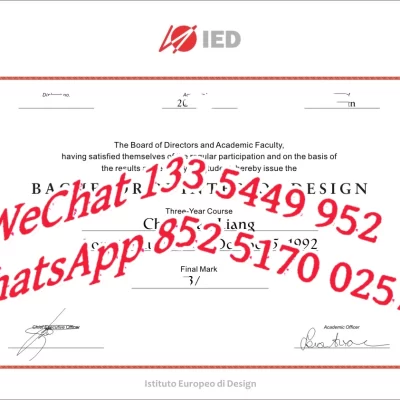
This is false. IED courses leading to a Diploma Accademico di Primo Livello are accredited by the Italian Ministry of University and Research (MUR). The resulting degree certificate is equivalent to a Bachelor of Arts (180 ECTS) and is recognized in the European Higher Education Area. Graduates receive both a diploma and a Diploma Supplement, making it possible to apply for master’s degrees at other universities worldwide or seek employment with valid academic credentials.
Misconception 2: “IED Is Only for Italian Speakers.”
Over 60% of Master’s courses and a growing number of Bachelor’s courses are entirely in English. Language support is integrated, and international students can access free Italian lessons on campus.
Misconception 3: “IED Is Just Another Private School; Any University Degree Is Better.”
While IED is a private institution, its project-based training often results in stronger portfolios than those from traditional theory-heavy universities. Employers in fashion, automotive, and design agencies frequently prioritize IED’s practical graduates.
Misconception 4: “You Can’t Work During Your Studies.”
In Italy, non-EU students with a valid residence permit can work up to 20 hours per week. IED’s Career Service actively helps students find part-time internships in studios and brands, which can later convert into full-time employment.
Misconception 5: “IED’s Diplomas and Degree Certificates Cannot Be Authenticated in China.”
The Academic Diploma (Diploma Accademico) falls under the AFAM system (Alta Formazione Artistica e Musicale) and is recognized by the Chinese Service Center for Scholarly Exchange (CSCSE). Provided the student has obtained a valid graduation certificate and the required Declaration of Value or CIMEA statement, the certification process is straightforward.
Frequently Asked Questions (FAQ) About IED for International Students
1. Is an IED Degree Certificate Officially Recognized Worldwide?
Yes, the Diploma Accademico di Primo Livello is a state-recognized degree certificate within the EU’s Bologna Process. For global recognition, students should request the Diploma Supplement at graduation. In China, it can be verified by the CSCSE as a bachelor’s level qualification.
2. Can I Transfer My IED Credits to Another University?
IED issues a compliant transcript with ECTS credits. Many European and UK universities accept these credits for advanced entry. Always check bilateral agreements before applying.
3. What Is the Difference Between the IED Diploma and the Academic Diploma?
The IED Diploma is a private school certificate without state legal value; the Academic Diploma is an accredited qualification granted by the Italian MUR and has the full effect of a university bachelor’s degree. International students aiming for a government-recognized graduation certificate should select programs marked “Diploma Accademico.”
4. How Can I Obtain My Official Transcript and Diploma After Completing the Program?
Upon successful completion and clearance of all fees, IED’s registrar issues the final transcript and the degree certificate. These are provided as hard-copy originals and digital versions. Students can request additional copies for a fee.
5. Does IED Offer a Foundation Course for Absolute Beginners?
Yes, IED runs One-Year Foundation Programmes in Milan, Florence, Rome, and Barcelona. These courses require a secondary school graduation certificate and are designed for students with zero design experience. A transcript from this course can support progression directly into the first year of a BA Academic Diploma.
6. Can I Work in Italy With a Student Visa While Studying at IED?
Non-EU students with a study residence permit (Permesso di Soggiorno) are allowed to work up to 20 hours per week and full-time during vacations. IED’s Career Service assists with part-time opportunities related to the field of study.
7. What Career Support Does IED Offer for International Students?
IED has a dedicated Career and Placement Office that organizes portfolio reviews, company visits, and an annual recruitment fair. The mandatory internship embedded in most Master’s programs frequently results in a job offer. Alumni report high employability in fashion houses, design agencies, and automotive brands across Europe and Asia.
8. How Do I Choose Between IED, NABA, and Marangoni?
-
IED is ideal for students who value a project-based, multidisciplinary approach across multiple cities, with strong product and transportation design options.
-
NABA offers a larger fine arts and painting focus alongside design.
-
Istituto Marangoni is more narrowly centered on fashion and luxury, often at a higher tuition cost.
Your choice should depend on the specific major, desired campus location, and whether you want an academic degree certificate versus a private diploma. If a recognized official qualification and a balanced tuition cost are priorities, IED’s Academic Diploma is the most straightforward path.