Is a KTH Royal Institute of Technology Degree Respected Globally? A 2026 Guide for International Students
A degree certificate and transcript from KTH Royal Institute of Technology carry formidable weight in engineering, ICT and sustainability, routinely placing graduates in top-tier firms across Europe, yet Chinese and zero-Swedish applicants face a stark reality: only two English-taught bachelor’s, annual tuition up to SEK 260,000, a crushing housing squeeze and a labour market where Swedish remains a de facto requirement for many permanent roles. This no-nonsense guide unpacks history, subject dominance, admission rules, real costs, and what that diploma actually unlocks—so you can judge whether KTH is the right launchpad for your career.
Quick facts at a glance (2026 data)
| Item | Detail |
|---|---|
| Full name | KTH Royal Institute of Technology (Kungliga Tekniska högskolan) |
| Founded | 1827 |
| Location | Stockholm, Sweden |
| Global ranking | QS World University Rankings 2026: #74 (Source: QS Quacquarelli Symonds 2026) |
| English-taught bachelor’s | 2 programmes (Source: KTH Admissions 2026) |
| English-taught master’s | over 60 (Source: KTH Admissions 2026) |
| Tuition fee range (non-EU/EEA) | Bachelor’s: SEK 155,000/year; Master’s: SEK 155,000–260,000/year |
| Living cost requirement | SEK 8,568/month (Swedish Migration Agency 2026) |
| Application deadline (autumn 2026) | 15 January 2026 for most programmes |
What Is the History and Cultural Heritage of KTH Royal Institute of Technology?
Why Was KTH Founded in 1827, and How Did It Shape Swedish Industry?
KTH Royal Institute of Technology was established in 1827 to drive Sweden’s industrialisation, originally named the “Technological Institute.” It evolved into a full university, and its alumni built much of modern Sweden’s infrastructure—from power grids to telecommunications. Located on the historic Valhallavägen campus in central Stockholm and the modern KTH Kista campus in Sweden’s Silicon Valley, KTH has supplied engineering talent to companies like Ericsson, ABB, Scania and Spotify. The iconic main courtyard, surrounded by 19th-century redbrick buildings, is still the site of graduation ceremonies where every new degree certificate is celebrated as a link in that long industrial chain.
How Does KTH Blend Innovation with Swedish Academic Traditions?
KTH’s culture prizes problem-solving, autonomy and close industry collaboration. Unlike classic student-nation universities like Lund, KTH’s social life is anchored in its powerful chapter-based student union (THS) and a packed calendar of tech events, hackathons, and the legendary Quarnevalen parade. The ethos is less about medieval ritual and more about building things. For an international student, obtaining a diploma from KTH means joining an alumni network that views engineering as a public good. That culture can be intensely motivating—but also demanding, with a steep learning curve and an expectation that students master Swedish if they want to integrate beyond the international bubble.
Historical timeline at a glance
| Year | Milestone |
|---|---|
| 1827 | Technological Institute founded, initially a small school with one professor |
| 1877 | Renamed KTH (Kungliga Tekniska högskolan), gains university status |
| 1910s | Main campus on Valhallavägen built; produces first wave of industrial leaders |
| 1960s–70s | Rapid expansion in computer science, nuclear and materials research |
| 2000s | Kista campus established in Stockholm’s ICT hub, hosting Ericsson and others |
| 2020s | Leading centres in sustainable energy, quantum technology and AI |
What Are KTH’s Top-Ranked Subjects and Global Advantages?
In Which Engineering and Technology Fields Does KTH Rank Among the World’s Elite?
KTH is not a broad-based university—it is a focused powerhouse of technology and architecture. According to the QS World University Rankings by Subject 2025 (the most recent full release before the 2026 cycle), KTH places within the global top 50 in multiple engineering domains:
| Discipline | QS Subject Rank (2025) | Why It Matters |
|---|---|---|
| Electrical & Electronic Engineering | #26 | Deep ties to Ericsson, ABB; research in 5G/6G, wireless, power electronics. |
| Mechanical Engineering | #31 | Strengths in production systems, mechatronics, and vehicle engineering. |
| Materials Science | #39 | Advanced steel, biomaterials, and sustainable material development. |
| Architecture & Built Environment | #44 | Only Swedish architecture school with a strong international profile. |
| Computer Science & Information Systems | #45 | Focus on AI, cybersecurity, visualisation; Kista campus incubates start‑ups. |
| Civil & Structural Engineering | top 100 | Sustainable urban planning, infrastructure and transport systems. |
| Chemical Engineering | top 100 | Process technology with a green chemistry emphasis. |
(Source: QS TopUniversities 2025; KTH Programme Pages 2026)
KTH’s master’s in Sustainable Energy Engineering, Machine Learning, Systems, Control and Robotics, Nuclear Energy Engineering, and ICT Innovation are routinely oversubscribed. The academic transcript from such programmes frequently becomes a passport to PhD positions or jobs in R&D across Europe and Asia. Prospective employers recognise that a KTH degree certificate signals not only theoretical depth but also extensive hands-on laboratory and project work.
How Does KTH Compare to Other Top Nordic Technical Universities?
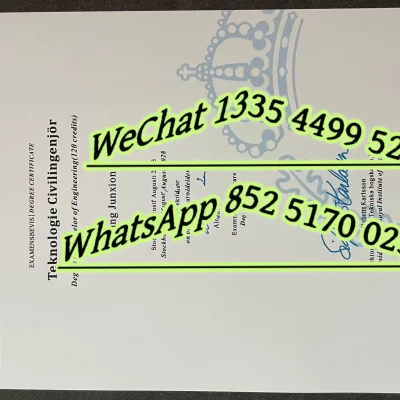
In the Nordics, KTH and Chalmers University of Technology in Gothenburg are the two premier engineering schools. KTH is larger, older, and situated in the capital—offering more corporate proximity but also a higher cost of living. Chalmers, with a more intimate campus, excels in areas like shipping and materials. For an international student viewing the diploma as a global career asset, KTH’s brand recognition in Asia and Europe is marginally stronger, although both provide world-class education. ATS-friendly educational certificate verification is straightforward, as KTH is fully accredited and part of the Bologna Process, meaning your degree certificate and transcript are issued in bilingual form (Swedish-English) and follow ECTS standards.
Who is KTH best for?
Students targeting engineering, ICT, energy or architecture who can handle intense competition and are prepared to learn Swedish for the job market. It is less suitable for someone seeking a broad liberal arts education or a low-stress university experience.
How Do International Students Apply to KTH in 2026?
What Are the Entry Requirements for KTH Bachelor’s and Master’s Programmes?
All applications go through universityadmissions.se. For 2026 entry, non-EU/EEA students must clear the following:
Bachelor’s programmes (only 2 in English)
-
Information and Communication Technology (ICT) and Engineering Sciences are the sole English-taught bachelor’s. They demand advanced mathematics and physics from upper secondary school.
-
Chinese applicants: Senior High School Graduation Certificate + Gaokao results, or IB/A-Levels. A Gaokao score in a rigorous science track is typically expected.
-
English: IELTS Academic 6.5 (no band below 5.5), TOEFL iBT 90 (writing minimum 20). The language hurdle is standard, but competition is extreme—hundreds of top applicants vie for a small cohort.
-
You must upload official educational certificates and a complete transcript from your upper secondary school in the application portal.
Master’s programmes (over 60 English-taught)
-
Recognised bachelor’s degree (180 ECTS) in a closely related engineering or science field. Specific credit requirements (e.g., 30 ECTS in mathematics, programming for CS) are strictly enforced.
-
English: IELTS 6.5 (no section below 5.5) or TOEFL iBT 90 (writing ≥20). Some programmes may accept a previous degree taught in English.
-
Supporting documents: degree certificate and transcript of records, statement of purpose, CV, two letters of recommendation. A portfolio is required for architecture and some design tracks.
-
KTH’s selection is based heavily on academic merit and the match between your prior coursework and the programme’s prerequisites. Work experience is a plus but rarely substitutes for missing credits.
English-Taught vs Swedish-Taught: What Can a Zero-Swedish Applicant Study?
A zero-Swedish student can obtain a full KTH bachelor’s or master’s degree certificate solely through English instruction—but at the bachelor’s level, the choice is extremely narrow (only two programmes). All other undergraduate courses require Swedish proficiency proven through TISUS or equivalent. At master’s level, English is ubiquitous and you will never need Swedish for lectures or exams. However, KTH strongly recommends free Swedish language courses (offered through its unit for language and communication) to improve internship and employment prospects. The diploma itself is issued in a bilingual format, so your 学历证明 (proof of education) is easily verifiable internationally.
Step-by-Step Application Timeline for Chinese Students (Autumn 2026 intake)
-
October 2025: Application opens at universityadmissions.se. Check KTH’s specific prerequisites.
-
15 January 2026: Hard deadline for most bachelor’s and master’s applications. All documents—including certified degree certificates and transcripts—must be uploaded.
-
February 2026: Pay the application fee (SEK 900).
-
Late March 2026: First admission results released. Non-EU students must accept their place swiftly.
-
April–May 2026: Apply for housing through KTH Accommodation or SSSB; apply for a residence permit.
-
June–August 2026: Complete the residence permit application (see FAQ). Arrive for orientation and, if needed, collect your KTH student diploma envelope at the welcome fair—but actually, your real degree certificate will come at graduation.
(Source: KTH Admissions 2026)
How Much Does It Cost to Study at KTH Royal Institute of Technology?
Tuition Fees for Non-EU Students in 2026
Non-EU/EEA and Swiss citizens pay application and tuition fees. For the 2026 academic year, KTH’s official fee bands are:
| Level | Fee per year | Programmes |
|---|---|---|
| Bachelor’s | SEK 155,000 | Both ICT and Engineering Sciences. |
| Master’s | SEK 155,000–260,000 | Most engineering/CS: SEK 155,000–200,000; Architecture: SEK 260,000; some joint programmes higher. |
(Source: KTH Tuition Fees 2026)
Living Costs and Required Funds
The Swedish Migration Agency demands proof of SEK 8,568/month for the 2026 study permit, i.e., SEK 102,816 for a 12-month permit. Actual spending in Stockholm is higher: a realistic monthly budget is SEK 10,000–12,500, broken down as:
-
Student accommodation: SEK 4,500–7,500 (subsidised corridor rooms are cheaper but scarce)
-
Food, transport, phone, insurance: SEK 4,000–5,000
-
Leisure and unforeseen: SEK 1,500–2,000
Stockholm’s housing crisis is acute; some students spend the first month in hostels. Thus, bringing extra savings equivalent to 3–4 months’ living expenses is strongly advised.
Scholarship Opportunities for Chinese Students
-
KTH Scholarship: Covers tuition only; awarded to a very small number of academically outstanding fee-paying master’s students.
-
Swedish Institute Scholarships for Global Professionals (SISGP) : Full funding (tuition + living costs) for master’s applicants with leadership experience from selected countries, including China. Highly competitive.
-
China Scholarship Council (CSC) : Joint PhD programmes; not usually for full master’s, but possible in bilateral agreements.
Most Chinese students are self-funded, so ensuring a robust financial plan for at least the entire first year before arriving is essential.
What Are the Common Misconceptions About Studying at KTH?
-
“KTH guarantees a job at Ericsson or Spotify.”
The degree certificate opens doors, but it does not hand you a contract. While KTH’s career fairs are packed with recruiters, landing a permanent role in Sweden usually requires Swedish language skills, networking, and relevant internships. Graduates in software and AI have better odds; mechanical or civil engineers often face a language barrier in the Swedish market. -
“If I study in English, I never need Swedish.”
Academically true—your transcript and diploma will be fully in English. But for daily life and the job market, learning Swedish is a major advantage. KTH offers free courses; ignoring them is a strategic mistake. -
“KTH is just a cold, hard tech school with no student life.”
The THS student union runs over 100 clubs, from robotics to choir to a full-scale student pub (META). The Quarnevalen parade and the Spring Ball are huge events. The culture is less traditional than Uppsala’s but equally tight-knit. -
“Living in Stockholm is unaffordable.”
It’s expensive, but student discounts, subsidised housing (if you queue early), and the right to work unlimited hours during studies make it manageable. The real danger is not budgeting for the initial housing search. -
“A KTH master’s is just a stepping stone to a PhD.”
While many programmes are research-oriented, KTH’s industry connections mean the degree certificate is equally valued by R&D departments and tech firms. You can pivot to either path after graduation. -
“I can skip the prerequisite subjects if my overall GPA is high.”
KTH is notoriously strict on prerequisites. If you lack 30 ECTS of mathematics for a CS master’s, your application will be rejected regardless of your overall grade. Treat the transcript requirement list as inflexible.
Frequently Asked Questions
1. How does KTH compare to Chalmers University of Technology?
Both are elite Swedish engineering schools. KTH (QS 2026: #74) is larger, older, and based in Stockholm; Chalmers (QS 2026: #129) is in Gothenburg with a more intimate campus. KTH has the edge in electrical engineering, ICT and architecture; Chalmers excels in shipping, materials and automotive. Your diploma from either is highly respected, but KTH’s brand is more widely recognised internationally.
2. Does KTH offer a foundation year or pre-engineering pathway for international students?
KTH does not run a foundation year. Students who do not meet entry requirements must upgrade their qualifications externally—e.g., through a recognised international foundation programme or Swedish adult education (Komvux). A conditional offer is not issued for missing prerequisites; you must present a complete educational certificate that fulfills all requirements by the deadline.
3. Are all master’s programmes at KTH taught in English?
Yes. Over 60 master’s are in English; a handful of specialised tracks (e.g., teacher training in technology) require Swedish. A degree certificate from an English-taught KTH programme is globally usable, and the transcript is issued in English.
4. What English tests are accepted for Chinese applicants in 2026?
IELTS Academic 6.5 (no band below 5.5) or TOEFL iBT 90 (writing 20+) . KTH also accepts Cambridge C1 Advanced/C2 Proficiency, and an upper secondary or bachelor’s degree conducted entirely in English. The test must be valid at the time of application.
5. How do I apply for a residence permit for studies in Sweden?
After receiving an admission offer and paying the first tuition installment, apply online to the Swedish Migration Agency. You need: admission letter, passport copy, proof of funds (SEK 8,568/month), and comprehensive health insurance if the permit is for less than one year. Processing can take 2–4 months; initiate immediately after accepting your place.
6. Can I stay and work in Sweden after graduating from KTH?
Yes. Non-EU graduates can obtain a residence permit for seeking employment, valid for up to 12 months. Once you secure a qualifying job, you switch to a work permit. KTH graduates in software, AI, electrical engineering and energy have strong employment pipelines, but learning Swedish remains the single most effective step to broaden your options.
7. Is it possible to complete a full KTH degree with zero Swedish?
Absolutely. All required teaching, exams, and official 文凭 (diploma) issuance for English-taught programmes are in English. Stockholm is one of the most English-proficient cities in the world. However, for internships and permanent employment, Swedish is a powerful asset.
8. How competitive is admission to KTH, and what does the university look for?
Competition is stiff. English-taught bachelor’s programmes may receive over 30 applicants per place. For master’s, the evaluation is primarily based on your prior transcript, the match of your undergraduate courses to the programme’s prerequisites, and your statement of purpose. A strong degree certificate with high grades in the required subjects is the baseline, not a guarantee.
(All FAQs are based on KTH, Swedish Migration Agency and universityadmissions.se 2026 data.)
This article gives Chinese and international students a transparent, data‑anchored picture of what it means to earn a degree certificate and transcript from KTH Royal Institute of Technology—a world-leading technology university where academic rigour meets industrial relevance, but where success requires strategic financial planning, early housing action, and a realistic commitment to learning Swedish for the long term.